Anticipation
· · · · · ·

Anticipation

Anticipation

Today is the day: IMMORTAL is being released. It’s out on shelves in bookstores and available for shipping from Amazon and B&N and wherever else books are sold. Actually, a friend bought it a few weeks ago at a sly and impatient B&N downtown. Which is all good.

I am happy to have it out, after the years of writing, revising, and slogging through the publishing process, which moves at the speed of continental drift.

I hope readers enjoy the book, that they take pleasure and fun and perhaps a piquant idea from it. Let me know.

Species of real & unreal
·

Species of real & unreal

Here’s the thing about being a healer: we have a different geometry of reality than many people do. It’s partly a siddhi thing, as described by Patanjali in his Yoga Sutras; if you start meditating regularly, trying to “cease the fluctuations of the mind,” you automatically begin to experience paradigm-busting phenomena. Sooner or later, you just do. It just happens. Some meditators see stuff, blobs of light, or colorful radiance around folks, or forms of energy-consciousness that used to be living people–or not. Meditators who aren’t particularly visual hear things, or sense things, or simply have wordless understandings that things are other than they seem.
Patanjali cautions against the siddhis, but I think they’re useful. What we experience for ourselves has a deeper impact than what we take on faith. But Patanjali has a a point, and caution is imperative. If you’re not grounded, extraordinary perception can quickly morph into delusion. Think Heaven’s Gate and Jim Jones and all those prophets who wafted astray, and sadly carried others with them.
Over the last several months I’ve become acquainted with noted UFOlogist Budd Hopkins, who is a celebrated artist as well as a researcher into something that a lot of people want to put down to fantasy and mass hysteria, swamp gas and reflection, urban myth and attention-seeking. One or two of his paintings hang in the MOMA. His UFO books are carefully, thoughtfully written and researched. He believes extraterrestrials are here, observing and abducting and experimenting. I’ve told him that I know they’re here in the astral plane, which is as real as the physical plane. But I haven’t verified for myself that ET’s are here in 3-d flesh, if flesh is what they have.
But the astral plane is a reality. Specifically, it’s a resonance of love and spirit, of relationship and dreams. And it’s a wide spectrum resonance. It drops into demonic curses and rises up into the blissful, transcendent songs of angels. It isn’t as dense and concrete as physical reality, but it affects people in the physical plane. It affects bodies and minds and emotions. Medical journals have published studies about the efficacy of prayer, the very stuff of astral beingness, on long distance subjects. The astral plane is palpable. It’s perceptible.
Which brings up another kind of reality I’ve experienced a lot of recently: teenage reality. It’s its own universe of perception and axiom, based on teenagers’ absolute certainty of their own invulnerability, infallible wisdom, and rectitude. They know everything. Based on 13 or 17 years on the planet, and what their friends tell them is so. Negotiating this fanaticism is treacherous, heart-aching, often simply impossible. Reason, decades of experience, logic, concern, love, etc. don’t make a dent in the monolithic dogmatism. A friend of mine said she’d read that the unhappiest people are those with teenage children. It’s at this point that I’m glad that the astral plane is real. The prayers that I constantly utter for my daughters have a chance of reaching them, of helping and protecting them.
From Sundance
· ·

From Sundance

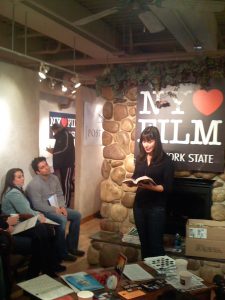
I’m reading from my forthcoming novel “Immortal” at the Sundance Film Festival. Specifics: today at 2:30 at the NY Film Lounge, 545 Main Street. The opportunity to do this makes me sound much cooler than I actually am; I’ve been reconciled to my inner nerd for many years. But it’s a fun way to promote this novel, and I’m having a good time here.

There aren’t as many celebrities as I’d hoped. I’ve heard of a few, but laid eyes on none. What there are is a lot of people who passionately involved in a creative art. Mostly film people, and they love what they’re doing. From what I can tell, they’re simultaneously exhausted and exhilarated by Sundance. They’re amped up on creative juice while also slogging through the scutwork it takes to bring any ethereal idea into physical reality and widespread distribution.

It’s great to feel this ferment of hard work and inspiration, determination and inventiveness. Sure, film people often have an annoying monovision: film is everything to all people, it’s all there is! And they all dress in a uniform here on the mountain, and they’re proud of that: jeans, sweater, uggs, with a loud “VIP” badge dangling from their necks.

But this is all easily forgiven because of their passion and often courage in bringing unusual ideas into the medium of film, and hoping to share it with the masses. Last night I went to one of those parties that I’d read about, but never thought I’d attend. At a mansion in a gated mountaintop community, a place with its own basketball court in the basement, thirty people serving caviar hors d’oeuvres, and, everywhere, open tubs of ice, containing bottles of Stella for the plucking. There was a live band, a raucous group of Brooklynites called the Jones Street Boys who played blue grass with Southern aplomb.

It was a treat to behold the lavishness. More importantly, I bumped into some interesting people. There was a woman who told me she was producing a film based on the memoir of a blind French resistance leader.

“Wait,” I cried, “You mean Jacques Lusseyran?” She nodded with delight and surprise.

“How do you know him, and his book ‘And there was light’?” she asked.

“I used to be a healer,” I told her. “That’s an important book for healers, about vision and seeing without the physical apparatus.” Indeed, it’s a wonderful book, one of my favorites. The producer seemed not to know what to make of my having been a healer. People often don’t. But for me, it was a thrill to think that a cherished book had a possibility of making its way into mass consciousness, where it can nourish and uplift everyone.

· ·

On Gratitude: Trikonasana & the Dyson vacuum cleaner

On Gratitude: Trikonasana & the Dyson vacuum cleaner

Arctic winds are breezing across Manhattan, so I decided not to go out to the gym. Instead I rolled out my yoga mat and went into my practice. Within a few moments, as my muscles warmed, stretched and opened, I was asking myself, “Why don’t I do this every day?”

It’s such a pleasure to feel myself grounding deeply into my body, to sense the fabric whole. This, even when my hip flexors complain and my hamstrings ache. It’s a sweet ache. Another ten minutes and the ache merges into my breath, and it’s all one thing: me, the practice, the pain, the warmth, tension flexing into motion, into resonance. After forty-five minutes and a delicious shavasana, corpse pose, I’m another Traci. A better one.

And I love my Dyson vacuum cleaner. I love what it represents: individual inventiveness. And it works good, too.

· · ·

Down with Priesthoods

A certain person who has worked with Carlo Pedretti, the renowned Leonardo da Vinci scholar, told me that, during the restoration under the Sforza palazzo in Milan, working with the pedestal for Leonardo’s incomparable horse, Pedretti has uncovered new information about Leonardo’s use of perspective.

“But he’s saving it for when the time is right,” the person confided.
Oh, and when will that be? “You mean he’s selfishly hoarding it for when he’s concerned that his illustrious career is flagging,” I said, with my usual tact.
“No, no, he’s just waiting for the right time,” the person insisted.
“The right time?” I cried. “The right time is now! I hope some enterprising grad student takes initiative and posts the information on the web!” The person stiffened and wandered off, drink in hand.
The point is that Leonardo da Vinci does not belong to Professore Pedretti, no matter how many decades Pedretti has invested in him. Leonardo belongs to the world. Leonardo belongs to humanity. If Pedretti has uncovered new information about Leonardo, who is one of the top ten most interesting people in history, Pedretti has a moral obligation to share it as fast as possible with as many people as possible. To sit on this information for any reason is petty selfishness of the worst sort. It reeks of Pedretti’s personal quest for power and glory, gain and status. It is corrupt.
I stand for the democratization of knowledge. But this places a terrible burden on civilians like me. The priesthoods who want knowledge concentrated within their own hands are not going to dispense that knowledge with any kind of grace. We have to bring ourselves to it, and work to understand.
Nowhere is this more easily visible than in science. Scientists don’t make it easy for non-scientists to understand what the hell is going on, and this is a big problem, because right now, scientists run the world. By that I mean they control what we eat, what we drink, what we breathe, what medicines we are administered, and so forth. Americans are, right now, guinea pigs in a giant laboratory experiment regarding genetically modified foods. Sure, an apricot with a few fish genes spliced in is shinier. But is it really, REALLY just as healthy as the regular kind of apricot that has a few speckles and brown spots, and a full complement of apricot genes, and only apricot genes? No one can really say for sure. Our grandchildren will be able to tell us, because their bodies will show the results of eating fishy apricots.
And don’t think the American Government is going to protect us. The FDA is nothing more, and nothing less, than a shill for the chemical, pharmaceutical, and biotech companies. In the American Government’s quest to concentrate wealth in the hands of a few people who own a lot of companies, and to reward those who help them do that, under the venal slogan that “The business of America is business,” scientists from biotech companies like Monsanto regularly leave their company position to work in the FDA when their company needs a product approved. There is no objective neutral analysis of data, because companies that have to spend the money to get through the approval process want to recoup that money as fast as possible. Is anyone really surprised that pharmaceutical companies were only releasing those trials that had the positive results they wanted? Corruption isn’t confined to scholars.
· · ·

Art historians, modern literary crap & the stink of scientology

I found myself writing to a former professor that the translator of Vasari’s “Lives of the Artists” should be taken out behind the ivy tower and shot in both knee-caps. The reason being that the “Lives” are wonderfully gossipy and dishy, once the reader gets past the god-awful diction. Unfortunately, and unforgivably, the frequent infelicities of language make it hard for a reader to stay that long. We should be indulging ourselves in guilty pleasure, the naughty deliciousness of scoping out intimate, graphic details of the actual personalities of master artists from Cimabue to Sansovino. Instead we’re slogging through a contorted, antiquated dialect of English to which it is very hard to relate.

So regular, civilian readers do not get to savor these all-too-human lives. Thus the ravishing nourishment they offer the soul passes from our collective awareness. We’re left with the fetish of reality TV, which is probably another post on how the decline of story is a barometer for the decline of civilization.

So what is it about art historians and scholarship in general that demands impenetrable rhetoric? Does writing that badly prove how smart they are, because the rest of us can’t understand it? Or are they just boorish and don’t care how sentence after crabbed, meaningless sentence affects their readers? I read a lot of art history for research purposes for my novels, and I am boggled by how badly written most of these books are.
And it’s not just art history that’s poorly written. People in the publishing industry complain about how there are fewer readers every year. Well, why do they expect people to partake of the meal, when the fare consists mostly of wormy fruit and twinkies? Take what is considered literature these days. Ninety nine percent of it is precious, self-congratulatory, and self-referential, with unlikeable characters. It’s an absolute dereliction of a novelist’s duty to write that way.
Self-reference and self-congratulation has been a post-modernist virus, nurtured carefully by the moral relativism of psychotherapy. I am all for self-esteem, but in my opinion, we are not going to build it within ourselves by telling ourselves that whatever we do is okay. We are going to earn it. By acting in honorable ways: keeping our word, choosing integrity, behaving with courtesy and respect for others, accomplishing difficult and worthwhile tasks, and so forth. By returning to those old-fashioned values that have stood the test of millennia. Let me state right now that I do not refer to perfectionism, with is a virulent form of self-hate. Nor have I been a paragon of model behavior. I’ve made a lot mistakes, broken a whole bunch of the 10 Commandments, and hurt plenty of people. But that’s not who I want to be. I aspire to better.
And I think that self-reference is what puts people off about scientology, despite the enormous appeal and considerable talent of its most famous proponent, Tom Cruise. There’s this queasy sense of arrogant self-entitlement that radiates out from scientology, so it doesn’t feel like a religion with any spirituality to it. Spirituality has to do with love, charity, kindness and compassion that elevate beyond the self.