
anarchy · criminal behavior · errors · evil
Dump the Dump: No garbage facility in a residential area, NYC
Dump the Dump
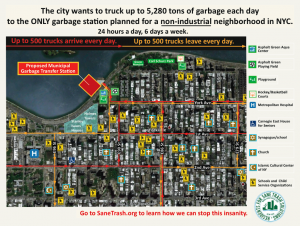
No giant garbage dump belongs in a residential community. Especially not one where over a hundred thousand children use the athletic facilities every week.
NYC has had its share of ambitious, cold-blooded politicians who, in their quest for power, care nothing when people get hurt. Speaker Christine Quinn is one of those politicians.
Speaker Quinn has openly boasted of her lust for higher office, and of her certainty that since she “has” Staten Island and the Bronx, she doesn’t need Manhattan. She’s certainly got it in for the Upper East Side–and the hundreds of thousands of children who attend school or participate in athletics there every single week.
Appropriating seductive ‘green’ terminology and the rhetoric of fairness–“Manhattan needs to do its fair share with trash”–Speaker Quinn has ardently supported a giant garbage processing facility at E. 91st street that will hurt East-Harlem and Yorkville. The euphemism being used for this 10 story plant, to which up to 500 garbage trucks will roll every day, is “marine transfer station.”
This garbage dump–let’s NOT use the political euphemism by which Speaker Quinn proposes to damage an entire neighborhood–will run 6 days a week, 24 hours per day. It will require a huge ramp to be built, and this ramp will literally bisect one the city’s most beloved, and most used, athletic facilities: Asphalt Green.
This neighborhood is home to dozens of schools, and the air pollution will rise by a minimum of 16%.
Noise levels, with hundreds of heavy garbage trucks rolling through every day, will rise beyond legal limits.
The East River estuary will be poisoned.
Shockingly enough, the City admits all of this in its reports!
Moreover, NO MONEY will be saved. Just the opposite, in fact. This abomination will require a new tax on New Yorkers–a garbage tax. At a time when money is already being cut from essential programs.
Worse, the Independent Budget Office prepared a report showing that the cost of this facility has skyrocketed beyond reason. The cost has risen from $55 million to more than $245 million. Many people expect it to reach $400 million.
From the website sanetrash.org:
There Are Sane Trash Solutions:
The City plans to dump garbage at the MTS and then ship that trash on barges to costly and environmentally unfriendly landfills that have not been identified yet. That multi-step, hugely expensive process, which will send “garbage barges to nowhere,” is not a sane solution. It is much more sensible to continue what the City is currently doing—transporting much of Manhattan’s residential trash in clean air vehicles directly to a “waste to energy” plant in New Jersey. The garbage is then converted to much-needed electrical energy.
The City plans to dump garbage at the MTS and then ship that trash on barges to costly and environmentally unfriendly landfills that have not been identified yet. That multi-step, hugely expensive process, which will send “garbage barges to nowhere,” is not a sane solution. It is much more sensible to continue what the City is currently doing—transporting much of Manhattan’s residential trash in clean air vehicles directly to a “waste to energy” plant in New Jersey. The garbage is then converted to much-needed electrical energy.
That is a sane solution that preserves precious resources, and answers the City’s “borough equity” argument: other boroughs will not be absorbing Manhattan’s residential garbage that is disposed of in this way. It is not equitable to single out our residential neighborhood as the only one in the City with an industrial municipal waste facility.

PLEASE:
START CALLING SPEAKER QUINN’S OFFICE: 212 564 7757 OR 212 788 7210 and let her know:
TRASH DOES NOT BELONG IN A RESIDENTIAL COMMUNITY JUST TO FURTHER YOUR POLITICAL AMBITION.
Moreover, the cost of building this plant has escalated wildly from $35mm to over $250 mm and
The Health and Safety of East Harlem and Yorkville is in serious danger!
SAVE THE COMMUNITY WHICH EDUCATES AND OFFERS SPORTS TO HUNDREDS OF THOUSANDS OF CHILDREN!
Note that garbage trucks have one of the highest pedestrian death accident rates!!